Bench test · 19 Nov 2026
Bluetooth dartboards: latency, pairing and the app that has to keep up
A connected dartboard is a board plus a radio plus a phone. The board's scoring is real-time, the app's is not, and the gap is where the user's trust breaks.
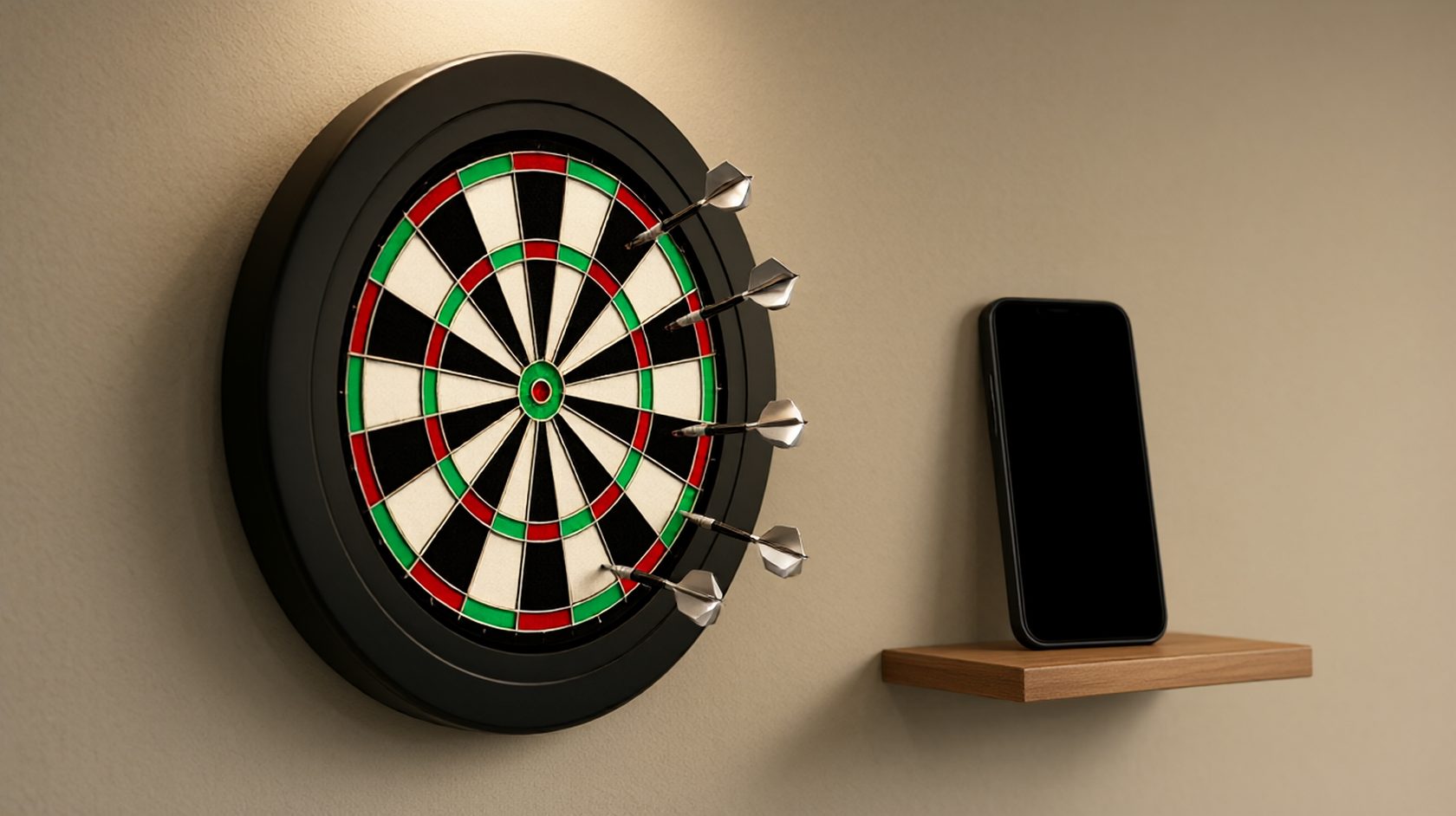
Three clocks in one game
The board registers a hit within milliseconds, the radio sends it within tens of milliseconds, and the phone renders it within a frame. Three clocks, and the user perceives only one.
Latency becomes visible when the app shows the score after the player has already thrown the next dart. At that point the player stops trusting the display and starts watching the board.
The target is that the app's score appears before the next throw, which for a league player is about four seconds. Anything under a second is invisible; anything over three seconds is felt.
A board that reports its own hit timing and a log of transmission delays is a board that can be diagnosed. A board that reports only the score is not.
Pairing, reconnection and the phone that goes to sleep
A Bluetooth connection is not a cable. It drops when the phone sleeps, when the user walks away, and when another device interferes on the same band.
The board should buffer hits while disconnected and replay them on reconnection. A board that loses the misses when the link drops is a board that loses the game.
The app should reconnect automatically and tell the user when it has. A silent reconnection is indistinguishable from a working link until a score is missing.
The pairing flow should be one action, not a menu. A board that requires the user to forget a device and re-pair is a board that generates support calls in its first week.
Multiplayer, local and remote
A connected board can host a local match between two players in the same room, with the app as the scoreboard. That is the simplest use case and the one that has to work first.
Remote play needs a server, an account and a match protocol. Each of those is a source of failure that the local mode does not have.
The match protocol should be defined before the app is built: who scores, who confirms, and what happens when the two devices disagree. A protocol without a disagreement rule produces arguments between players.
A board that can play locally without an account is a board that works on a plane and in a basement. Requiring an account for local play is a design choice that loses customers.
The app as the product's weakest component
An app is updated by the brand and by the phone's operating system, and the board is not. A board that depends on an app inherits the app's lifecycle.
The board's firmware should be updatable, and the app should degrade gracefully when the firmware is older. A version mismatch that disables scoring is a product that stops working after a year.
The app's permissions should be minimal: Bluetooth, and nothing that it does not need. A dartboard that asks for contacts is a dartboard that will be reviewed badly.
The app should also work offline for a local game, which means the game logic lives in the board or is cached. A cloud-dependent app is a product with a server bill and an outage risk.
Data, accounts and what the board remembers
A connected board can keep statistics: averages, checkout rates, doubles hit. That is the feature that makes an app worth installing, and it is also the feature that needs data to be durable.
Statistics stored only in the app are lost when the phone is replaced. Statistics stored on the board survive, and exporting them is a small feature with a long tail of goodwill.
The account should be optional and the data exportable. A brand that holds a player's history without an export is a brand that owns the customer's history.
The privacy policy should say what is transmitted and what stays on the device. A board that sends every throw to a server should say so plainly.
Testing the link before shipping
Test with three phone models and two operating systems, at a distance of five metres with a wall between. The lab test passes; the house test is the one that matters.
Test for an hour continuously, because Bluetooth failures often appear after the phone has slept twice and the app has been backgrounded.
Test the buffer: disconnect the phone mid-game, throw ten darts, reconnect, and confirm all ten are scored. That test finds the replay bugs.
Record the results in the technical file. A connected product without a link test record is a product whose reliability is unknown.
The phone as the weak link
A dartboard's app runs on a phone that may be three years old, low on storage and running a battery saver. The app has to work on that phone.
The app's memory footprint and its background behaviour should be specified, and the minimum supported device should be published rather than discovered.
Battery optimisation on some phones kills a background app, and the dartboard silently stops syncing. The app should ask the user to exempt it, and explain why.
A board that works without the app is a board that survives a bad phone, and that is the design principle behind local scoring.
Radio interference in a bar
A bar is a radio environment: Wi-Fi access points, tills, card readers, and dozens of phones. The 2.4 GHz band where Bluetooth lives is crowded.
The board's antenna should be placed away from metal and from the board's own power supply, and the enclosure's material should not block the radio.
A metal cabinet around a connected board is an antenna problem, and the fix is an external antenna or a plastic window in the cabinet.
The specification should state the radio module, its antenna and the tested range in a crowded environment, not only in free space.
Firmware updates and the board that bricks
A firmware update over Bluetooth is a risk: the link can drop, the phone can leave, and the board can be left with half an image.
The update should be resumable and the board should keep a fallback image. A board that bricks on a dropped update is a board that returns to the factory.
The update's trigger should require the board to be idle and the phone to be close, and the app should show progress rather than a spinner.
A board that has never had an update is a board that will receive one in year two, and the update path is designed now or never.
The second player's phone
A two-player game with two phones needs a clear model of who is the authority. If both phones claim to score, the game will disagree with itself.
The board should be the authority, and the phones should display. A phone that also scores is a source of divergence.
The protocol should have a revision number and a rule for a mismatch, and the rule should be to refuse the match rather than to guess.
A board that is the authority is a board that can work with one phone, two phones, or none, and that is the design that lasts.
The practice mode and the data it leaves
A connected board's practice mode records every throw, and that record is the product's most useful feature after the game itself.
The statistics should be computed on the board or cached locally, so that a practice session works without a server. A mode that requires the cloud is a mode that fails in a basement.
The data should be exportable in a simple format, and the format should be documented. A player who can move their history to a new board is a player who buys the same brand again.
The privacy question is the same as everywhere: say what leaves the board, and make the answer small.
The short version
The radio is a convenience and the locality is the product: a board that scores, buffers and replays without the app is a board that works in a basement and survives a bad phone.
The app's job is to display and export. When it starts to be the authority, the product inherits every phone's problems.
A board that buffers hits through a dropped link is the Bluetooth dartboard, and its local-play mode is what makes the radio a feature rather than a dependency.
What to check
- App score displayed under one second after a hit
- Hits buffered and replayed after a disconnect
- Automatic reconnection with a visible indicator
- Local play available without an account
- Firmware updatable, with graceful version mismatch
- Link test on three phones, five metres, one wall, one hour