Bench test · 19 Nov 2026
The base station is the product: auto-empty, mop wash and the plumbing nobody specifies
A robot vacuum's day-to-day experience is decided by the dock, not the robot. The dock's pumps, bags and water paths are where the failures live.
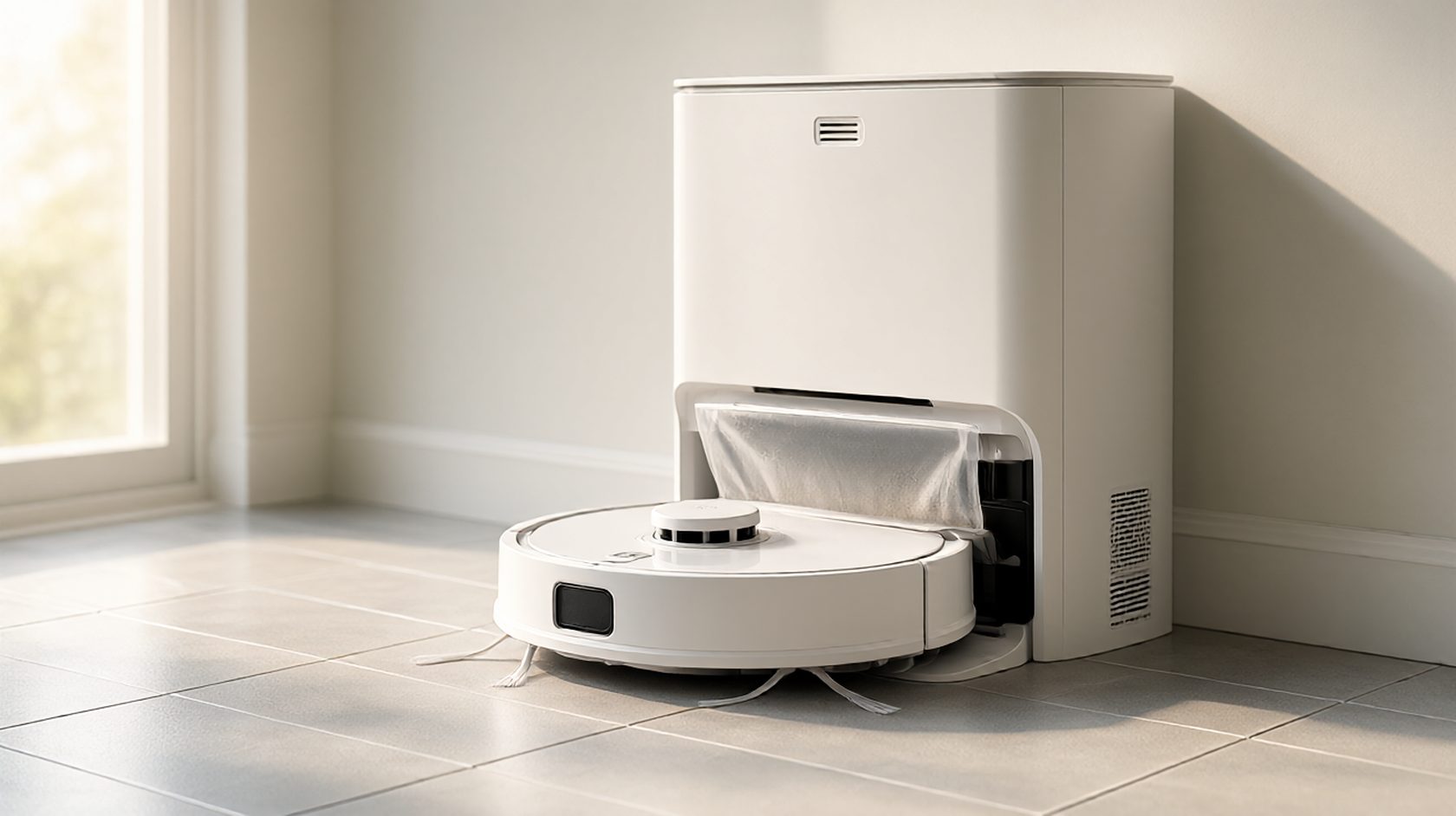
What a dock actually does
A base station charges the robot, empties its bin into a bag, and on the mopping models washes the mop and dries it. Each of those is a small machine with its own failure modes.
Auto-empty uses a fan and a sealed path from the robot's bin to a bag. The seal is the critical part: a leak reduces the airflow and the bin is emptied only partially.
Mop washing adds a water tank, a pump, a wash tray and a drying fan. Water plus dust equals sludge, and sludge is where the odour complaints start.
The dock is the part of the system that stays in one place for years, and it is the part most likely to be described as 'smelly' in a review.
The bag, the seal and the dust that escapes
A dock bag is a filter as well as a container. A bag with a poor seal lets fine dust into the dock's internal cavity, where it accumulates and eventually reaches the fan.
The visible symptom is dust around the dock's lid and a bin that empties less completely over time. The cause is usually a bag that is not seated, or a gasket that has hardened.
A bag that is too small fills quickly and the airflow drops before the robot's bin is empty. The bag's volume should be specified against the bin's volume and the cleaning frequency.
The bag should also be easy to remove without a dust cloud. A bag with a rigid collar and a flap is the design that works; a bag that is a soft pouch inside a cavity is the design that spills.
Mop washing, water quality and the tray
A wash tray that is not drained and dried becomes a biofilm reactor within a week. The design has to drain completely and dry actively, not merely stop washing.
The water tank's material matters: a translucent tank with a wide mouth can be cleaned, a sealed tank with a narrow fill port cannot.
The drying fan's airflow should reach the mop's full width. A fan that dries the centre and leaves the edges wet produces the smell that the drying function was meant to prevent.
A dock that washes with cold water and dries with unheated air is cheaper and slower. The specification should state the water temperature and the drying time, because those two numbers are the difference between a fresh mop and a damp one.
Pumps, valves and the maintenance schedule
A peristaltic pump is cheap and self-priming, and its tube wears. A diaphragm pump is more expensive and quieter, and its valves can clog with scale.
The maintenance schedule should name the pump type and the tube's replacement interval. A dock without a stated interval is a dock whose pump fails in year two.
Scale is the enemy in hard-water areas. A dock that draws from a tank filled with tap water will scale, and the scale will reduce flow before it blocks.
The manual should say to use filtered water, and the design should make the tank removable for descaling. Both are cheap and both extend the dock's life.
Placement, clearance and the floor it stands on
A dock needs clearance in front for the robot to approach, and clearance behind for the bag and the cable. The installation guide should give both dimensions as numbers.
A dock on a thick rug tilts, and a tilted dock misaligns the robot's charging contacts. The symptom is a robot that docks intermittently and a battery that is never full.
The dock's own weight and the robot's push mean the dock can walk on a smooth floor. A rubber pad under the dock is the cheapest fix and it should be in the box.
The installation guide is part of the product. A dock that is installed badly performs badly, and the customer blames the robot.
The dock as a service item
Bags, mop pads, filters and wash trays are consumables, and their availability decides the product's useful life. A dock with a proprietary bag that is discontinued is a dock that becomes furniture.
The brand should publish the consumable part numbers and their expected life. That publication is a commitment, and it is the thing a buyer should check before choosing a model.
A dock with a reusable bag option is more sustainable and messier. The trade is a product decision, and it should be offered rather than decided for the customer.
The consumables' cost per year is part of the product's total cost, and a specification that ignores it is comparing purchase prices rather than products.
The cable, the dock and the first week
A dock is installed once and then judged for years. The installation's three decisions are the power outlet's position, the clearance in front and the floor's slope.
A dock whose cable runs across the approach path is a dock the robot will climb. The cable should be routed behind or under, and the manual should show the routing.
The dock's indicator lights should be visible from the room's entrance, not only from the floor. A user who cannot see the status will press buttons until something happens.
The first week's failures are installation failures, and the manual's installation section is the product's first quality control.
Water tanks and the refill ritual
A mopping dock's clean-water tank is filled by the user, and the ritual decides whether the mopping function is used. A tank that is awkward to remove is a tank that stays empty.
The tank should be removable with one hand, have a wide mouth and a visible maximum line. Three details that turn a chore into a habit.
The dirty-water tank, where present, should be emptied after every wash. A dock that holds dirty water for a week is a dock that smells, whatever the drying function does.
The manual should say how often to empty, and the app should remind. A reminder is cheaper than a complaint about odour.
Dust bags, filters and the consumable chain
A dock's bag and the robot's filter are both consumables, and their intervals interact: a loaded robot filter sends more dust to the bag, and a full bag reduces the robot's emptying.
The app should track both and give a single replacement prompt rather than two. A user who replaces one and not the other will see the performance fall anyway.
The consumables should be orderable from the app, and the part numbers should be printed on the parts themselves. A bag with no part number is a bag the user will guess at.
The chain from part number to availability is the product's after-sales design, and it is as important as the dock's engineering.
The dock's noise and the night schedule
A dock's auto-empty burst is loud for a few seconds, and a robot scheduled at three in the morning will wake a light sleeper.
The schedule should have a quiet window, and the dock should defer its burst until the window ends. A product that cannot be scheduled around sleep is a product that is switched off.
The dock's wash and dry cycles are audible for longer than the empty burst, and their timing should be configurable rather than fixed to the robot's return.
A night schedule with a quiet wash is a feature that a household with children will notice, and it costs software rather than hardware.
The short version
The dock is the product. Bags that seal, trays that drain, mops that dry across their full width and pumps whose lives are stated are the four things that decide whether a dock feels like a convenience or a chore.
Ask for the consumable part numbers and their prices before the model comparison. A dock whose parts cannot be bought is a dock with a fixed life.
For a dock that has to wash, dry and empty without becoming a service call, the all-in-one base station robot vacuum is the unit to open: its bag collar and its tray drainage are the two details that decide the smell.
What to check
- Bag volume, collar design and seal quality
- Wash tray drainage and active drying of the full mop width
- Water temperature and drying time stated
- Pump type and tube replacement interval
- Dock clearance dimensions and anti-slip pad
- Consumable part numbers and expected life published