Bench test · 19 Nov 2026
Robot vacuum navigation: what LDS, dToF and a camera actually buy you
Three navigation systems are sold as one feature. They fail in different rooms, at different prices, and with different consequences for the furniture.
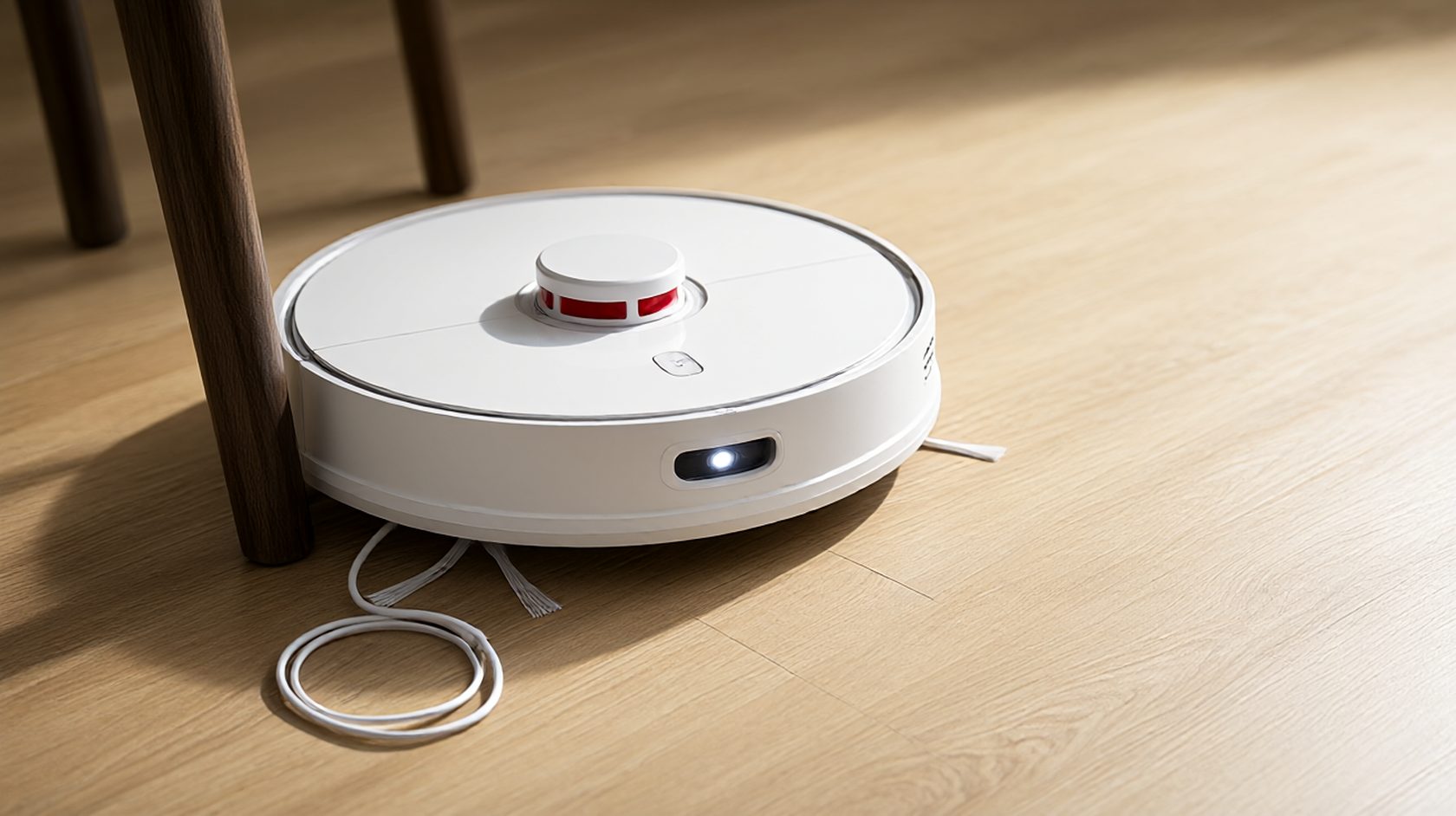
The three systems, briefly
A laser distance sensor, usually spinning, measures the distance to walls and objects in a horizontal plane. It builds a map of the room's perimeter and of the obstacles it can see at that height.
A direct time-of-flight module measures the round trip of a light pulse to a point, which gives depth rather than a distance along a line. It sees low objects that a horizontal laser plane passes over, and it works in the dark.
A camera uses visual features and, increasingly, a trained model to recognise objects. It can tell a cable from a shoe, which the other two cannot, and it needs light and processing power to do it.
The marketing conflates all three under 'AI navigation'. The technical difference is what each sensor can and cannot see at the height where a robot actually travels.
What a horizontal laser misses
A spinning laser sits a few centimetres above the floor, and its plane passes over a sock, a phone cable and the base of a floor lamp. The robot sees a clear path and drives into the object.
This is not a failure of the sensor; it is a geometry problem. The laser's plane is a line at a fixed height, and anything below it is invisible until the bumper touches it.
The consequence is that a laser-navigated robot needs a tidy floor, and its marketing should say so. A robot sold as 'obstacle avoidance' that only sees tall obstacles is a robot that will eat a charging cable.
The mitigation is a low bumper with a mechanical sensor, plus software that slows down when the bumper is triggered. It is cheap and it is the difference between a robot that survives a cable and one that does not.
dToF and the low-object case
A time-of-flight module returns a depth map of the scene in front of it, including low objects, because it measures to a point rather than along a plane.
The resolution matters: a module with a narrow field of view gives detailed depth in a small window, and a module with a wide field sees more but coarser. A robot needs the wide version to avoid clipping a chair leg it did not map.
Dark objects absorb the light pulse and reduce the return, so a black mat or a dark rug can still be missed by a dToF sensor. The sensor is better than a laser plane and it is not omniscient.
The practical difference in a home is measured by how often the robot stops on a cable. A dToF robot stops less often, and the improvement is worth the price difference in a home with children.
Cameras, recognition and the privacy trade
A camera adds semantics: it can label a cable, a pet bowl or a slipper, and the robot can treat each differently. That is a genuine capability and not a marketing invention.
It also adds a data path. Images or features leave the device for processing in most implementations, and the privacy policy decides what happens to them.
The buyer's question should be where the inference runs: on-device inference keeps images local and is the better answer for a bedroom; cloud inference gives better recognition and a data trail.
A camera robot should also have a physical shutter or a clear indicator when the camera is active. That is a design decision, and it is the one a privacy-conscious buyer will check first.
Maps, multi-floor and the room that moves
A map is a model, and a model drifts. Furniture moves, a door is left open, and the robot's stored map no longer matches the room.
A good implementation re-localises on every start rather than trusting the map absolutely: it looks for landmarks, corrects its position, and updates the map when a wall has moved.
A poor implementation drives to a stored coordinate, finds a sofa, and behaves as though the sofa is an error. The symptom is a robot that circles in the wrong place.
Multi-floor storage is the same problem at a different scale. A robot that stores three maps needs a reliable way to know which floor it is on, and most implementations ask the user rather than detect it.
What to specify, and what to ignore
Specify the sensor combination, the bumper behaviour, the localisation method and the privacy arrangement. Four items that decide how the product behaves in a real home.
Ignore the pascal figure and the marketing adjectives. Suction is covered elsewhere; navigation is about whether the robot reaches the dirt without being stopped by a cable.
Ask for a demonstration in a room with a cable, a dark mat and a chair leg. Three objects that separate the three systems more clearly than any datasheet.
The demonstration is the specification. A supplier who will not run it is a supplier who knows the product fails it.
The threshold a robot cannot climb
A robot's climbing ability is set by its wheel diameter, its suspension and its centre of gravity. A two-centimetre threshold is a specification, and a three-centimetre rug edge is not.
The manual should state the maximum threshold in millimetres and the wheel diameter, because those two numbers predict whether the robot will cross the threshold in the buyer's hallway.
A robot that fails a threshold does not fail loudly. It turns, tries again and eventually gives up, and the user finds it in the wrong room.
The behaviour on a repeated failure should be to report it in the app rather than to keep trying. A report is a support call avoided, and a silent retry is a support call created.
Furniture, legs and the geometry of a chair
A chair leg is a vertical cylinder, and a robot's laser sees it clearly at its own height. The problem is the space beneath the chair, where the robot may or may not fit.
The robot's height, including the laser turret, is the constraint. A turret that adds ten millimetres can be the difference between cleaning under a sofa and skipping it.
The map should record the furniture it has seen and the spaces it has entered. A robot that has cleaned under a bed once should remember that the space is cleanable.
A robot that repeatedly attempts a space too low for it wastes battery and time. The software should learn the failure and stop attempting it after two tries.
The room that is never finished
A robot that cleans in a random pattern will eventually cover a room, and a robot that follows a planned path will cover it faster and more evenly.
The planned path is a set of parallel lines with a defined overlap, and the overlap is the number that decides whether a robot misses a strip between passes.
An overlap of ten per cent is usually enough for a clean floor and not enough for a carpet with a pile that scatters debris. The setting should be adjustable, and the default should be stated.
A room that is never finished is usually a room with a narrow gap or a threshold, and the app's map should show where the robot stopped. The map is the diagnostic tool.
The battery of sensors that disagree
A robot with a laser, a bumper and a cliff sensor has three opinions, and the firmware has to arbitrate. The rule is usually that the mechanical bumper wins.
A cliff sensor prevents a fall from a stair, and it is a separate sensor from the navigation system. A robot that relies on the laser for cliff detection will fall down a dark stair.
The arbitration should be documented, because the behaviour the user sees - a stop, a turn, a retreat - is the output of a rule that the datasheet never states.
A robot that stops unexpectedly is usually obeying a rule, not malfunctioning, and the app should say which sensor triggered the stop.
The short version
Buy the sensor combination that matches the room: a laser plane for a tidy floor, a depth sensor for cables and low objects, a camera only where the privacy arrangement is acceptable.
Ask for the demonstration, the arbitration rules and the map's diagnostic view. Those three answers settle the navigation question faster than any datasheet.
The machine whose navigation is built around a linear laser and a low bumper is the linear-laser navigation robot vacuum, and its behaviour on a cable is the test worth running first.
What to check
- Sensor combination stated (laser plane, dToF, camera or a mix)
- Bumper behaviour and slowdown logic
- Localisation and map-update method
- On-device versus cloud inference, and camera shutter
- Demonstration in a room with cable, dark mat and chair leg