Bench test · 19 Nov 2026
Soft-tip dartboards: what wears out, in what order, and how to design for it
A dartboard is a machine that absorbs energy two hundred times a night. The parts that fail are predictable, and the design can move the failure out of the warranty period.
The impact budget
A dart arrives with kinetic energy that the board has to absorb through the tip, the segment and the backing. The energy is small per throw and large over a season.
The segment's material decides how the energy is absorbed. A hard plastic segment transfers the load to the backing; a soft one deforms and spreads it.
The backing is the part that takes the accumulation. A foam backing damps the impact and limits the tip's penetration; a rigid backing lets the tip bottom out and wear the face.
The design should state the backing material and the expected penetration depth, because penetration is what the face has to resist.
Wear order: face, tips, segments, electronics
The face wears first, because every dart passes through it. The holes open, the surface crazes, and the accuracy falls before anything else fails.
The tips wear second, and they are consumable. A board sold without a tip supply is a board that is judged on its first hundred throws.
The segments wear third, at the wire edges and at the treble ring where the hit density is highest. A segment that has worn thin lets the tip through and produces a phantom score.
The electronics wear last, and they usually fail from the power supply or the switch membrane rather than from the processor. A board's electronic life is longer than its mechanical life.
Designing the face for replacement
A face held by screws from the front is removable; a face bonded to the matrix is not. The choice is made at the tool, and it decides whether the product can be serviced.
The face should be a single part, keyed so it can only be fitted one way, and retained by screws that are accessible without dismantling the board.
The service manual should give the replacement interval in throws or in months of typical use, and the part number. A manual without that interval leaves the decision to a customer who does not know the face is a wear item.
A replaceable face also extends the product's life and reduces electronic waste, which is a marketing story and a genuine benefit.
The wire, the bounce-out and the trade
Thin wires reduce bounce-out and wear faster. Thick wires last longer and reject more darts. There is no setting that optimises both, so the choice is a product decision.
The wire's material matters: a stainless wire holds its shape; a plated wire can flake at the tip contact point and produce a rough edge that raises bounce-out.
The wire should be tensioned rather than glued, because a glued wire that lifts at one end becomes a catch point that produces a consistent bounce-out at that segment.
A board designed for a bar will accept a higher bounce-out rate and a longer wire life; a board designed for a league will accept the opposite. The same platform can serve both with a wire change.
Power, standby and the board that is left on
A dartboard in a bar is left on for hours. The power supply's standby consumption and its heat are part of the product's reliability, because heat ages the electronics.
A supply that runs warm at idle should be external, so that the heat is outside the board's enclosure. An internal supply that warms the cabinet accelerates the display's failure.
The board should sleep when it is not in use and wake on a dart. A board that cannot sleep is a board that will be switched off at the wall, and a board that loses its settings when it is switched off is a board that annoys its owner.
The standby figure should be published. It is small, and it is one of the few numbers a bar owner will actually compare.
The service model
A dartboard's service model is consumables plus a replaceable face plus a warranty on the electronics. That model should be written before the product is designed, because it decides the tool.
Consumables - tips, flights, shafts and faces - should be available through the same channel as the board. A board whose consumables are hard to find is a board that is replaced rather than maintained.
The warranty should exclude wear items explicitly and name them. An exclusion that is written is a dispute that does not happen.
The parts list, the intervals and the exclusions are the product's after-sales design. They are as much a part of the specification as the segment count.
The cabinet and the wall behind it
A board absorbs most of the dart's energy, and the wall behind it absorbs the rest. A board mounted on plasterboard transmits the impact and loosens over a season.
The cabinet or the bracket should spread the load across a stud or a fixing plate, and the manual should say so. A board that falls off a wall is a warranty claim.
A surround - a foam ring around the board - catches the darts that miss and protects the wall. It is usually sold separately and it is the accessory that prevents most wall damage.
A board sold with a surround has a lower complaint rate than one sold without, and the surround's material should be specified as a closed-cell foam.
Lighting and the throw line
A bar board is usually lit from above, and a light that casts a shadow on the board makes the player throw worse and blame the board.
A ring light around the board's perimeter is the design that avoids shadow, and its colour temperature should be neutral rather than warm.
The throw line's distance is fixed by the game, and the board's packaging should include a line marker. A player who throws from the wrong distance has a different hit distribution and a different wear pattern.
The lighting and the line are part of the product's experience, and they are cheap to include.
Wear measurement, not wear opinion
A board's wear can be measured: count the hits per segment from the game logs, and compare the segment's condition at the treble and double.
A board with a hundred thousand hits per segment is a board at the end of its face life, and the face should be replaced before the accuracy claim is used in marketing.
The service interval should be expressed in hits rather than months, because a busy bar and a home are different by a factor of ten.
A board that reports its own hit count has the data for this. A board that does not has an interval nobody can follow.
The spare parts kit that sells the board
A board shipped with a spare face, a set of tips and a spare membrane is a board that a buyer trusts to last.
The kit's cost is small relative to the board, and its effect on the review is large, because the buyer sees the failure modes addressed before they occur.
The kit should be listed as a part number rather than as an accessory, so that it can be reordered and so that the support team can ship one.
A brand that sells the kit sells the maintenance model, and the maintenance model is what turns a first purchase into a second one.
The kit should also include the two fasteners and the key that the face needs, because a face that arrives without them is a face that waits in a drawer.
The short version
A dartboard is a wear machine with an electronic component, not the other way round. The face, the tips and the segments fail in that order, and the design decides whether the failure is a service call or a replacement.
A replaceable face, a published parts kit and a wire specification that names the bounce-out trade are what make a board last longer than its warranty.
The service interval belongs in hits, not in months, because a busy bar and a home differ by a factor of ten. A board that counts its own throws can follow the interval.
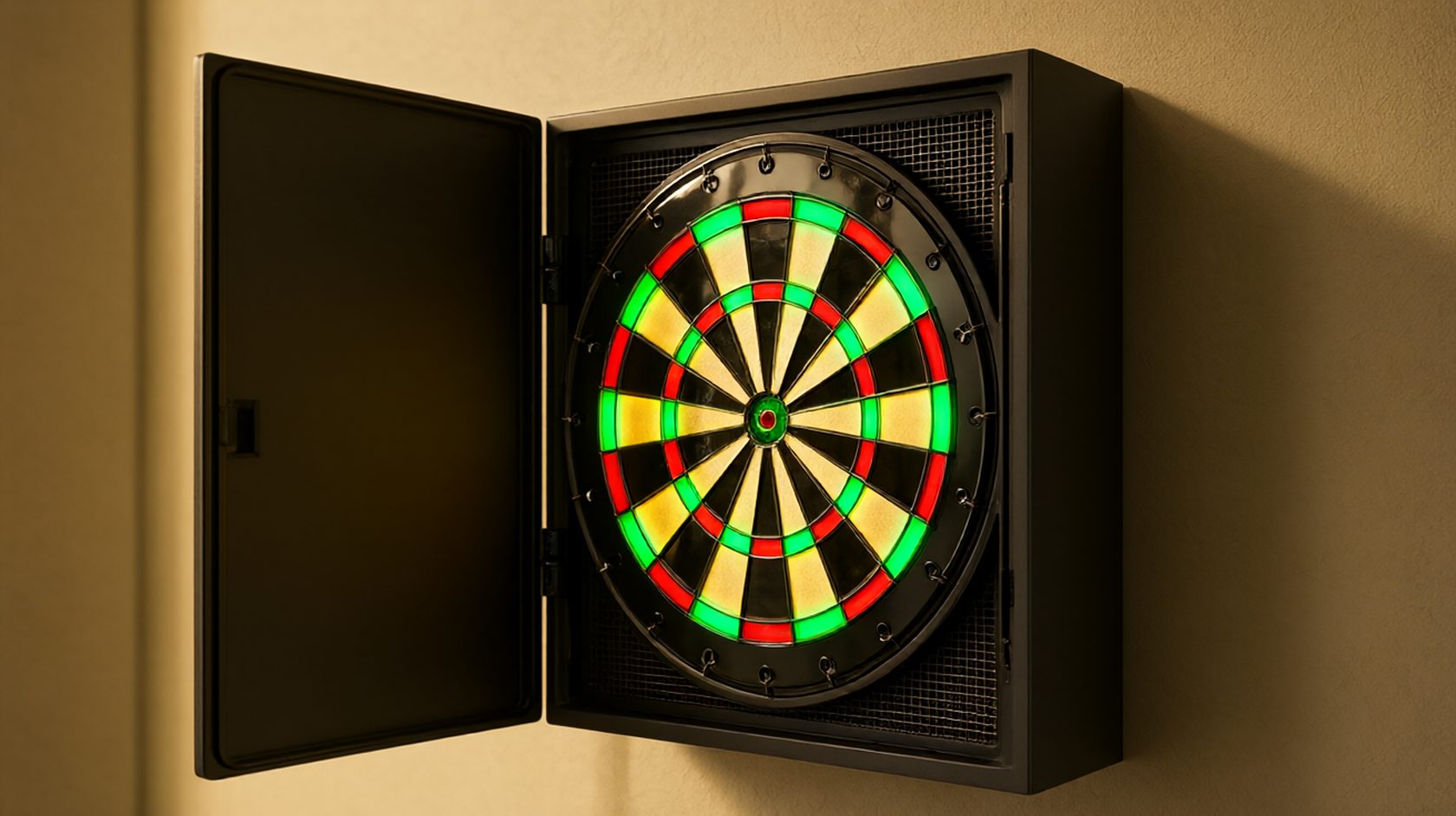
For a board that is expected to absorb a bar's worth of throws, the soft-tip electronic dartboard is the unit whose wire and backing are worth inspecting before the price.
What to check
- Backing material and expected penetration depth
- Face removable with accessible screws and keyed fit
- Replacement interval stated in throws or months
- Wire material, tensioning method and bounce-out trade stated
- External supply and published standby figure
- Consumables and wear exclusions written into warranty