Bench test · 19 Nov 2026
Suction specs: why the pascal number on the box is not the cleaning power
Every robot vacuum advertises a pressure figure. Pressure is only half of the equation, and the other half is the airflow the machine can sustain through a dirty filter.
Pressure, flow and the product of the two
Suction is not a single number. It is the product of the pressure difference the fan can generate and the airflow it can move at that pressure, and the two trade against each other along a fan curve.
A fan optimised for pressure moves little air and lifts a mat; a fan optimised for flow moves a lot of air and lifts loose dust. A robot needs both at different moments.
The pascal figure on a box is usually the maximum static pressure at zero flow, which is the point where nothing is being cleaned at all.
A useful specification gives the flow at a stated pressure, or the pair of numbers at the working point. A single maximum is a marketing number, not an engineering one.
The filter is the real limit
A robot's airflow passes through a filter, and a loaded filter reduces flow before it reduces pressure. A machine that starts at 1,200 pascals may be working at half that after ten minutes of fine dust.
This is why the same robot cleans well on a first pass and poorly on a second: the filter is loaded, and the airflow is gone.
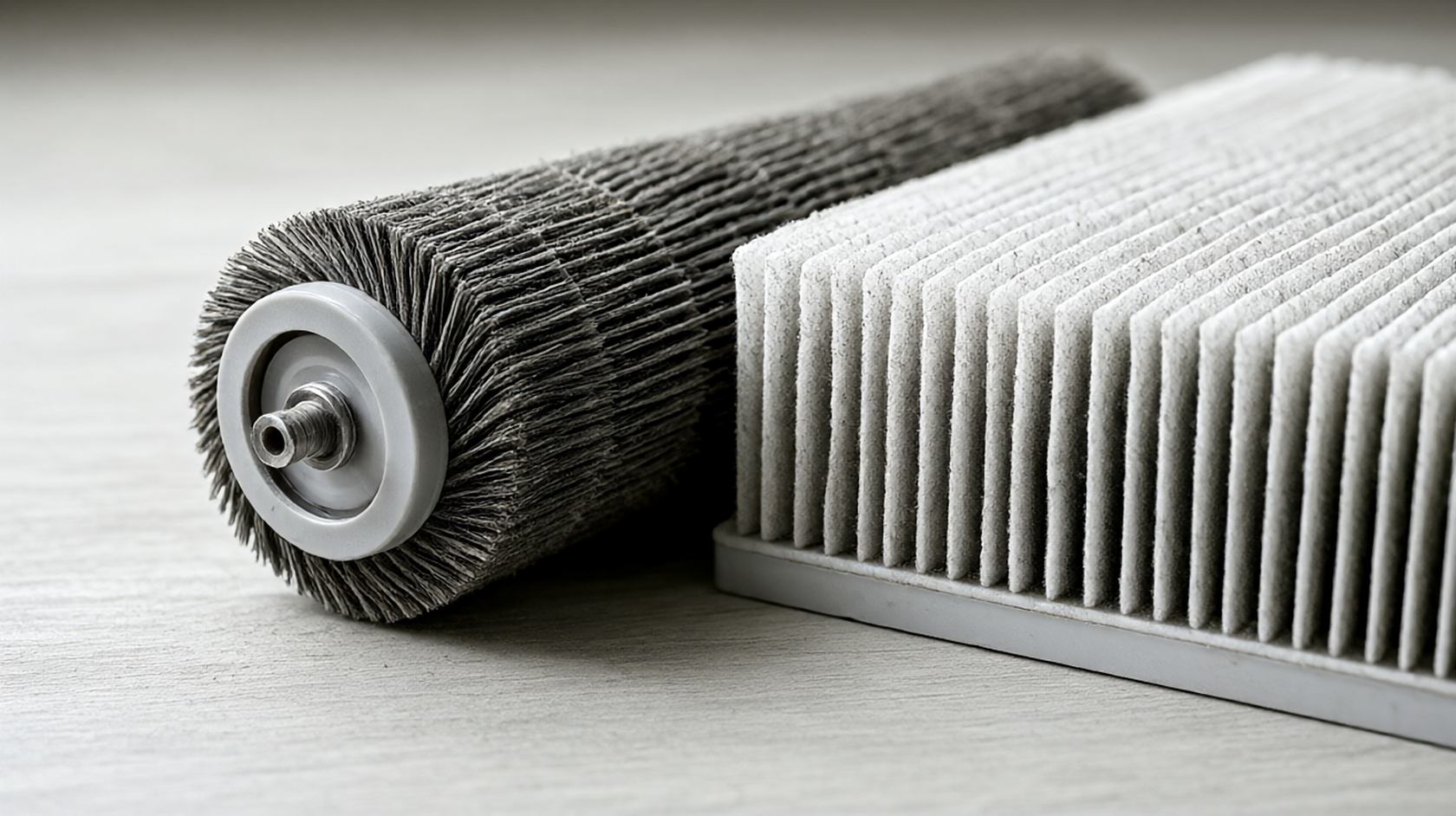
The filter's surface area is the design variable. A small pleated filter loads quickly; a larger one holds its flow longer. The box usually does not state the area.
The maintenance instruction should give a filter cleaning interval and a replacement interval. A robot whose filter is never cleaned is a robot that loses its suction quietly.
Brush, seal and the path around the dirt
A robot's pickup is a system: the brush agitates, the skirt seals, and the fan carries. A gap in the skirt lets air in from the room and the pickup loses its pressure at the floor.
The skirt is a wear item. A skirt that has curled loses its seal, and the symptom is a robot that leaves a line of dust along a skirting board.
A brush that is too stiff scatters debris; a brush that is too soft does not agitate. The rubber-and-bristle combination is the compromise that most manufacturers converge on.
The specification should name the skirt material and its replacement interval, and the brush type for the floor surfaces the product is sold into.
Noise, and the correlation with airflow
Airflow makes noise. A quiet robot is usually a robot with a lower flow, and a quiet mode that reduces flow is a mode that cleans less.
The noise figure should be given with the mode and the distance. A 55 dB figure measured at one metre in quiet mode is not comparable with a 68 dB figure in turbo mode at the same distance.
The noise that matters is the tone, not only the level. A high-pitched whine from a small fan at high speed is more irritating than a lower broadband noise at the same decibels.
A buyer choosing between two machines should compare the noise in the mode they will actually use, which is usually the standard mode rather than turbo.
Carpet, hard floor and the boost that is not free
Carpet needs more pressure and less flow than a hard floor; a boost mode increases fan speed and draws more power, which shortens the run time.
An automatic boost that detects carpet is a real feature, and its value depends on how reliably it detects the transition. A robot that boosts on a rug and stays boosted on a tiled floor wastes its battery.
The specification should state the run time in each mode on each surface, not one headline run time. A single figure is a figure for the easiest condition.
A test on the buyer's own floor is worth more than any of these numbers, and a supplier who allows a trial is a supplier who is confident in the product.
Dust bin size and the trade with airflow
A larger bin holds more dirt and reduces the airflow, because the fan has to move air through a bigger volume. The optimum is set by the cleaning frequency, not by the maximum.
A bin that is too small fills during a single clean and the robot's pickup falls away in the second half of the run.
A dock that empties automatically removes the size constraint and allows a smaller bin with better flow. That is the engineering reason auto-empty docks exist, beyond convenience.
A specification that states the bin volume without stating the empty mechanism is an incomplete specification.
The brush roll and the hair problem
A brush roll with bristles picks up fibre and holds it. A rubber roll resists hair tangles and picks up less fine dust.
The combination roll - rubber blades and bristles - is the compromise most brands ship, and its maintenance interval is shorter than the marketing suggests.
The roll should be removable without tools, and the manual should show the cutting tool for tangled hair. A roll that requires a screwdriver is a roll that is never cleaned.
A tangled roll reduces the airflow at the floor and looks like a suction fault. The first diagnostic step in any suction complaint should be the roll, not the fan.
The edge, the skirting and the missing centimetre
A robot's brush cannot reach the last few centimetres against a skirting board, because the chassis is round and the brush is inside it.
The side brush extends the reach, and its length and softness decide whether it flicks debris into the path or scatters it across the room.
A side brush that is too stiff damages furniture and wears quickly; one that is too soft does not reach. The specification should name the brush's material and its replacement interval.
A corner that is never cleaned is a corner the user will clean by hand, and the product's value falls accordingly.
Measuring suction at home
A buyer can compare two machines with a simple test: scatter a measured amount of rice on a hard floor and weigh what is collected after one pass.
The test should be repeated three times on the same area and the results averaged. The repeatability matters more than the absolute number.
A machine that collects ninety per cent on a first pass and ninety-five on a second is better than one that collects eighty and eighty-two, even if the second has a higher pascal figure.
The test's value is that it measures the system - fan, filter, brush and skirt - rather than one component's specification.
The filter that is washed and the filter that is not
A washable filter is a filter with a coating that survives water. A filter without that coating loses its electrostatic behaviour when it is washed.
The manual should say whether the filter is washable, how often, and when to replace it. A washable filter that is washed every week still needs replacing every few months.
A filter that is washed and not dried before use is a filter that smells. The drying instruction is part of the maintenance procedure.
The replacement filter's part number should be in the manual and on the app. A filter that cannot be found is a robot that is retired early.
The pet household and the hair it leaves
A household with a long-haired pet produces fibre that a robot's brush cannot fully handle, and the product's value depends on the brush and the filter together.
The brush should be a rubber blade design for a pet household, and the filter should be a larger pleated element that holds its flow.
The bin should be emptied more often, and the dock's auto-empty is the feature that makes the routine tolerable.
A pet household should be told which combination is recommended, and the recommendation should be in the product selector rather than in the footnotes.
The short version
Pressure is half a specification. The other half is flow through a loaded filter, and that is the number the box does not print.
The system - fan, filter, brush and skirt - is what collects the dirt. Test the system on your floor rather than comparing one number from two boxes.
Where the flow has to hold through a loaded filter, the all-round base station vacuum cleaner is the product to compare against, and its filter area is the number the datasheet leaves out.
What to check
- Flow at a stated pressure, not a single maximum pascal figure
- Filter area and cleaning/replacement interval
- Skirt material and wear replacement interval
- Noise stated with mode and distance
- Run time per mode and per surface
- Bin volume and whether the dock empties it